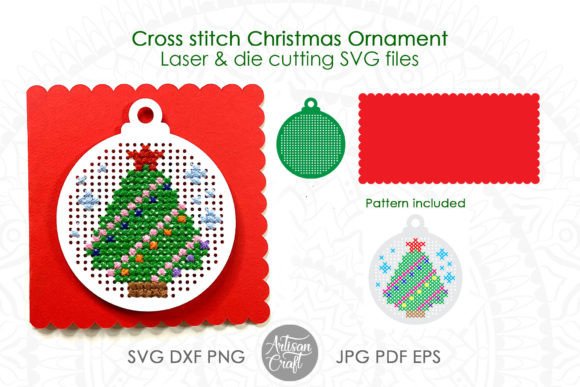
Cross Stitch Christmas Ornament SVG
First Impression: Festive, Handmade, and Booth-Ready
As an embroidery designer who’s packed 47 craft fairs in the last eight years, my first thought when I see Cross Stitch Christmas Ornament SVG isn’t “Is it pretty?”—it’s “Will it stop someone mid-aisle?” The title alone signals warmth, tradition, and tactile charm. It reads as festive but not frantic, handmade but not messy, and nostalgic without leaning into kitsch. That balance is gold for holiday markets. Customers scanning a booth full of glitter, plaid, and pine-scented candles respond to clarity—and this design promises just that: a clean, recognizable ornament shape with cross stitch texture implied or rendered, not overworked.
Where It Shines: From Booth Display to Etsy Listing
Cross Stitch Christmas Ornament SVG works strongest where handmade authenticity meets instant readability. On a folded tea towel laid flat on your table? Perfect. As a small embroidered patch sewn onto a denim market bag? Instant heirloom energy. As a focal design on a linen pillow cover beside a stack of hand-stamped cards? It elevates the whole display. It’s also unusually versatile across product types:
- Tote bag design: Works best centered low on natural canvas—small enough to avoid overwhelming, large enough to read from three feet away.
- Apron embroidery: Ideal above the pocket or on the bib—adds personality without competing with functional details.
- Tea towel embroidery: A top corner placement lets the ornament “float” against fabric texture, letting the cross stitch pattern breathe.
- Embroidered patch: Highly effective—its defined shape and moderate detail translate cleanly into stitched borders and fill.
- Fabric pouch & cap embroidery: Use scaled-down versions only; test fit on curved surfaces first—caps demand simplified outlines and open stitch areas.
Production Realities: What Sells vs. What Stalls
This isn’t just about aesthetics—it’s about flow. At a craft fair, you’re stitching, pricing, folding, chatting, and restocking—all before noon. Cross Stitch Christmas Ornament SVG supports batch production because its structure is predictable: one central motif, no sprawling vines or tiny floating elements. That means faster hooping, consistent thread changes, and fewer restarts. It photographs exceptionally well for Etsy listings too—clean lines hold up in thumbnail size, and the cross stitch suggestion adds visual interest even in grayscale mockups.
But here’s where attention matters: if the included cross stitch pattern suggests tight fills or micro-details (like seed stitches inside the ornament loop), those won’t translate on thick towels or dark fabrics without contrast testing. Likewise, any lettering—say, “Joy” or “2024” integrated into the design—must be at least 8mm tall to remain legible after stitching and washing. Always check the actual SVG file: does it contain layered paths optimized for cutting *and* stitching? Or is it purely decorative? Clarity at a glance separates impulse buys from “I’ll think about it.”
Careful-Use Notes Every Designer Should Flag
Even charming designs have limits. With Cross Stitch Christmas Ornament SVG, watch for:
- Dense stitch areas: High stitch density in small zones can pucker lightweight fabrics—use cutaway + tear-away stabilizer combo on tea towels and pouches.
- Tiny details: Ornament hangers, inner grid lines, or snowflake accents may vanish on textured terry cloth or heavy linen—simplify or omit in those applications.
- Curved cap surfaces: Avoid placing the full ornament across the front panel; instead, use just the top loop or a stylized outline.
- Dark fabric: If stitching on navy, charcoal, or black, confirm thread colors in the kit—or choose high-contrast metallics (gold, silver) to preserve visibility.
- Small sizes: Below 3 inches wide, the cross stitch illusion breaks down. Stick to accent use—e.g., a single ornament as a tag on a gift pouch—not as primary branding.
Why This Design Strengthens Your Brand & Booth
In a sea of laser-cut wood signs and resin coasters, Cross Stitch Christmas Ornament SVG quietly asserts craftsmanship. It doesn’t shout—it invites touch, conversation, and recognition. Customers see “cross stitch” and think “made with care,” even if it’s machine-embroidered. That perception lifts perceived value: a $24 embroidered tea towel feels like a keepsake, not just kitchenware. For Etsy sellers, it supports cohesive collections—pair it with matching card templates and printable gift tags from the same kit to boost average order value. And for boutique makers building seasonal lines, its graphic simplicity ensures brand consistency across packaging, social posts, and printed hang tags.
Embroidery Designer’s Must-Do Checklist
Before cutting your first fabric or uploading to Cricut Design Space, do this:
- Test the machine embroidery design on scrap fabric matching your intended product (e.g., terry cloth for towels, twill for caps).
- Check thread contrast—especially if using ecru thread on cream linen or charcoal on black denim.
- Review spacing between stitch clusters—tight crowding causes skipped stitches on dense fabrics.
- Confirm hoop size compatibility—some ornaments require 4x4 hoops minimum; others fit snugly in 3x3.
- Inspect stitch density—over 12,000 stitches in under 2 square inches needs extra stabilizer and slower speed.
- Use the right stabilizer: cutaway for stretchy knits, tear-away for stable wovens, and fusible + tear-away for tea towels.
- Create at least one real mockup—not digital, not printed—stitched, pressed, and photographed in natural light.
- Compare fabric colors side-by-side: a warm ivory vs. cool white changes how red/green threads read.
- Verify commercial licensing: the kit includes digital downloads, but confirm whether finished products may be sold commercially—this is non-negotiable for Etsy sellers and small shop products.
Final Thought: A Quiet Workhorse for Holiday Sales
Cross Stitch Christmas Ornament SVG isn’t flashy—but it’s reliable, evocative, and deeply aligned with what handmade shoppers seek in December: meaning, texture, and quiet joy. It’s the kind of digital embroidery file that becomes a staple in your holiday workflow—not because it’s trendy, but because it converts. Whether stitched on a linen pouch or printed as a card template, it carries the weight of tradition while feeling fresh in execution. For craft fair sellers, embroidery business owners, and creative entrepreneurs building real inventory? This is less a design—and more a sales partner.