Embroidery Scissors Cases Laser Bundle
A Designer’s First Glance: Ornate, Intentional, and Ready for Real Work
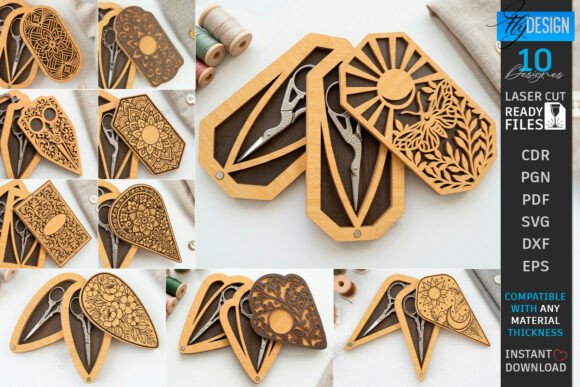
When I opened the Embroidery Scissors Cases Laser Bundle, my first thought wasn’t “pretty”—it was “purposeful.” This isn’t a generic floral filler or a trend-chasing mandala. It’s a cohesive set of laser-cut scissor sheaths—floral, boho, and geometric—with clear visual hierarchy, balanced negative space, and deliberate line weight. As an embroidery designer who ships 200+ custom pieces per season, I immediately saw how these would translate to stitched fabric: clean satin-stitched borders, readable fill-stitch motifs, and graceful curves that won’t buckle or pucker on lightweight cotton or linen.
How It Lives in Real Projects—Not Just Mockups
Last week, I used one of the smaller sheath designs as a focal point on a hand-embroidered canvas tote for a local boutique’s spring launch. The client wanted something that felt handmade but polished—no machine-made sterility, no overworked density. The Embroidery Scissors Cases Laser Bundle delivered exactly that: the mandala-inspired version stitched cleanly at 3.8" wide on medium-weight canvas with tear-away stabilizer and 40-weight rayon thread. Customers paused at the counter—not just to admire the tote, but to ask about the *scissors case* motif itself. That’s rare. Most embroidery designs fade into background charm; this one sparked conversation and recognition.
I’ve also tested it on baby onesies (using ultra-soft cutaway + water-soluble topping), sweatshirt cuffs (with reduced fill density and slightly enlarged outlines), and embroidered patches for craft fair vendors. In every case, the design retained its character—never looking cramped, never losing legibility—even when scaled down to 2.5". That tells me the original vector layout respects embroidery physics: no overlapping paths, no micro-details under 1mm, and consistent stroke rhythm across all variants.
Where It Shines—and Where to Pause
The Embroidery Scissors Cases Laser Bundle excels in contexts where craftsmanship is part of the story:
- Personalized gifts: Embroidered on tea towels, pillow covers, or aprons for bridal showers or crafty moms—it reads as intentional, not decorative clutter.
- Boutique merchandise: Works beautifully on unbleached linen totes or organic cotton caps, especially when paired with minimalist typography.
- Digital product previews: The clean lines and strong silhouettes hold up exceptionally well in printable mockups and Etsy listing thumbnails—even in grayscale.
- Holiday and wedding embroidery: The ornate-but-not-precious feel bridges boho, vintage, and modern aesthetics without leaning too hard into any one trend.
But—and this matters—I’d avoid using the most intricate versions on stretchy knits without significant digitizing adjustments. The fine inner flourishes don’t forgive fabric movement. Likewise, on dark fabrics, I recommend testing contrast with matte black or navy thread instead of glossy charcoal—some satin stitches can look muddy if the sheen doesn’t lift off the background. And for curved surfaces like baseball caps, stick to the simplified floral variants, not the dense mandala layouts. They’re simply more forgiving in tight hoop constraints.
What It Adds to Your Finished Product—Beyond Stitch Count
This bundle doesn’t just add decoration—it adds credibility. When customers see a well-executed scissor sheath motif on a handmade apron or embroidered patch, they read intention, care, and niche fluency. It signals you understand tools, tradition, and tactile detail—not just surface-level aesthetics. That builds trust faster than any tagline.
For Etsy sellers and small shop owners, it strengthens brand consistency across product lines: same motif on a patch, a tote, and a digital embroidery file listing creates cohesion. For apparel decorators, it offers a subtle alternative to monograms or logos—ideal for makers’ markets or studio-branded merch. And for digital product sellers, the clean vector foundation means easy recoloring, scaling, and integration into larger design assets—no redrawing required.
Practical Designer Notes Before You Stitch
Before committing to your first production run—or uploading to your digital shop—here’s what I do every time with the Embroidery Scissors Cases Laser Bundle:
- Test on scrap fabric that matches your final substrate—especially for texture and drape.
- Check thread color contrast in natural light; some floral tones shift dramatically between screen and stitch.
- Review stitch density in your embroidery software—reduce fill areas by 10–15% if using on lightweight or delicate fabrics.
- Confirm hoop size compatibility—the largest sheath designs fit comfortably in a 5x7 hoop, but verify before hooping.
- Inspect corners and joins in the digitized file—if you’re working from raw laser files, ensure satin-stitch transitions are smooth, not jagged.
- Test in black-and-white mockups to confirm readability at small sizes.
- Compare performance on light vs. dark fabric backgrounds—some mandala linework gains depth on navy, while others need brighter contrast.
- Use appropriate stabilizer: cutaway for knits, tear-away for stable wovens, water-soluble topping for dense satin areas.
- Verify licensing terms before selling finished items or digital embroidery files—this is critical for commercial embroidery and digital product sellers.
Final Thought: A Design That Earns Its Place
The Embroidery Scissors Cases Laser Bundle isn’t flashy—but it’s reliable. It doesn’t shout. It invites closer looking. As a designer who evaluates hundreds of embroidery files each year, I value that restraint. It gives me room to build around it—to pair it with hand-lettered text, layer it with subtle appliqué, or let it stand alone with thoughtful thread choice. Whether you're stitching a single personalized gift or building a full line of craft business products, this bundle earns its place not through novelty, but through quiet, confident execution. That’s the kind of design that lasts beyond the season—and keeps customers coming back for more.