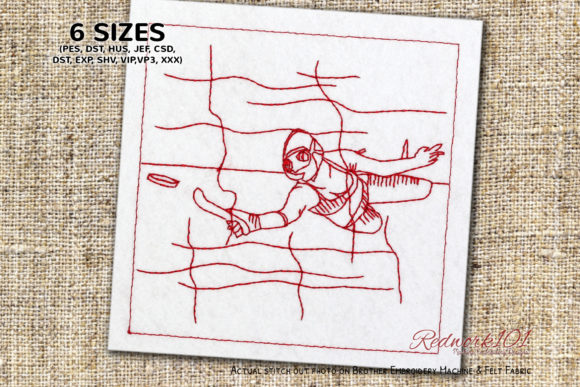
Underwater Hockey Player Redwork
First Impression: Playful, Bold, and Unapologetically Niche
As an embroidery designer who’s stitched everything from minimalist botanicals to intricate heraldic crests, Underwater Hockey Player Redwork hits with immediate charm—it’s a wink, a grin, and a splash of subversive energy all in one. The title alone tells you this isn’t generic nautical decor; it’s for the tiny, passionate tribe who strap on snorkels and push pucks along pool floors. That specificity is gold for boutique brands. Visually, “redwork” signals clean line work, folk-art simplicity, and strong silhouette readability—ideal for sweatshirt embroidery where subtlety often drowns in fabric texture. The mood? Lighthearted but confident. Not childish, not ironic—it’s authentically *playful*, with just enough detail (think curved fins, exaggerated goggles, maybe a puck mid-swim) to read clearly at 3–4 inches tall.
How It Lives on Real Sweatshirts
Underwater Hockey Player Redwork thrives on neutral sweatshirts—oatmeal, heather grey, soft black—where its redwork lines pop without competing. On dark fabric, it gains quiet authority: no need for white underlay if stitch density is balanced, letting the thread do the talking. Pastel hoodies? Surprisingly effective—mint or blush adds whimsy without undermining the design’s sporty core. For oversized hoodies, place it slightly higher on the chest to avoid swallowing; for cozy seasonal layers (think fleece-lined crewnecks or waffle-knit pullovers), its bold outline holds up beautifully against varied fabric textures.
This isn’t a background whisper—it’s a conversation starter. As a hoodie chest placement, it reads instantly. As a sleeve accent? Trim and clever—especially on rolled cuffs. As a back design? Scale it up thoughtfully (check your embroidery file’s largest recommended size) and pair with a small tagline like “Pool Floor Pro” for brand cohesion. For boutique merchandise, it leans into lifestyle storytelling: imagine it styled beside vintage snorkels, striped beach towels, or a stack of retro dive magazines in product photography.
Design Integrity Meets Commercial Practicality
Redwork’s inherent simplicity is a gift for commercial embroidery—but only if executed well. I immediately assess thread color contrast: true red-on-cream reads crisp; red-on-charcoal needs tight stitch density to prevent shadowing. Since the description notes “a wacky design for a wacky sport,” I assume intentional exaggeration—not sloppy drafting—so line consistency and smooth curves matter more than photorealism. A well-digitized Underwater Hockey Player Redwork will have clean jump stitches, minimal trims, and smart underlay for stability on knit fabrics.
Fabric thickness? Sweatshirts vary wildly—from lightweight French terry to heavyweight loopback. A medium-weight stabilizer (cutaway or tear-away, depending on garment care instructions) keeps puck outlines sharp and prevents puckering around curved elements like goggles or flippers. Hoop size matters less here than placement logic: this design works best centered or left-chest, avoiding seam intersections that distort tension. And yes—it must survive washing. Tight satin or stem stitches (typical of redwork) hold up better than dense fill areas, so if your embroidery file includes any solid fills, verify their density isn’t over 12,000 stitches per square inch for durability.
Small Shop Impact: Trust, Identity, and Handmade Warmth
For Etsy sellers and small shop owners, Underwater Hockey Player Redwork isn’t just decoration—it’s a trust signal. It says, “We know our people.” That specificity builds instant rapport with underwater hockey fans, a group starved for gear that doesn’t treat their sport as a punchline. When customers see thoughtful execution—clean edges, balanced thread tension, no stray jumps—they feel the care behind the handmade product. That perception lifts perceived value: a $78 hoodie with this design feels curated, not mass-produced.
Visually, it strengthens brand identity without demanding a full logo system. Use it consistently across your Beach Nautical collection—not as filler, but as a signature motif. Pair it with hand-lettered care tags or custom woven labels referencing “The Deep League” or “Puck & Plunge”—and suddenly you’re not selling apparel, you’re selling belonging. In mockup previews and printable mockups, its strong silhouette ensures clarity even at thumbnail size, boosting click-through on Etsy listings. And because it’s inherently memorable, customers start recognizing your boutique brand by that distinctive swimmer-puck pose—not just your shop name.
What You Must Verify Before Stitching
The product description hints at flexibility (“The Stitch Box shown in the picture is optional. The color of the outer box is a diffe…”), which suggests visual presentation options—but don’t assume. Before production, confirm:
- Whether the embroidery file includes alternate thread colors (e.g., navy or kelly green for non-red versions)
- If the “optional Stitch Box” is part of the design assets or a separate layout element
- Maximum recommended size for commercial embroidery—especially if scaling for back placements
- File format compatibility with your machine (DST, PES, JEF, etc.) and whether it’s optimized for multi-needle or single-needle use
None of these are flaws—just essential checks. A great Underwater Hockey Player Redwork should empower your process, not complicate it.
Final Thought: More Than a Design—It’s a Niche Anchor
In a market flooded with anchors, seashells, and generic “ocean vibes,” Underwater Hockey Player Redwork stands out by going deeper—literally and culturally. It’s not for everyone, and that’s its power. For small clothing brands building community over commerce, this machine embroidery design is a rare find: playful enough for Instagram, precise enough for premium sweatshirt embroidery, and distinctive enough to become your most-requested hoodie design. It turns a niche sport into wearable pride—and that’s how boutique brands earn loyal fans, one stitch at a time.