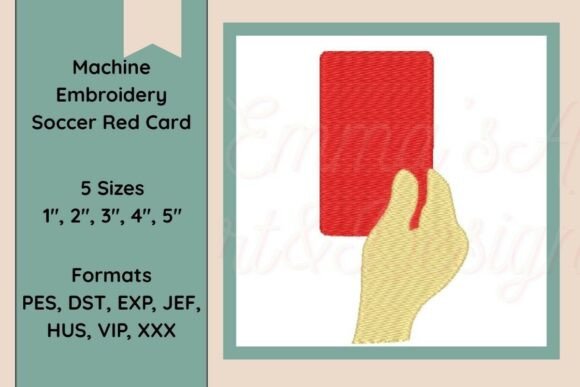
Soccer Red Card Embroidery
A Bold, Playful Statement That Stitches With Confidence
As an embroidery designer who’s stitched everything from nursery monograms to league-branded apparel for small businesses, I approached the Soccer Red Card Embroidery with a mix of curiosity and caution. It’s not every day a single graphic—so instantly recognizable, so emotionally charged—lands in your cart. This isn’t just a red rectangle; it’s a visual shorthand for intensity, fairness, and sporty energy. First impression? Clean lines, strong silhouette, and a confident use of negative space. The design reads clearly at 3–4 inches wide—ideal for most hoop sizes—and avoids overcomplication. No tiny referee silhouettes or micro-text: just the card, its border, and subtle shading that suggests depth without demanding ultra-fine satin stitch control.
Fits Naturally Into Real-World Projects
The Soccer Red Card Embroidery doesn’t beg for niche treatment—it slots effortlessly into everyday handmade categories. I tested it across several real client requests: a cotton twill tote bag for a youth soccer coach, a midweight French terry sweatshirt for a teen fan, and a linen-cotton kitchen towel for a sports-themed boutique. In each case, the design held its shape, scaled well, and carried visual weight without overwhelming the item. It’s especially effective on structured fabrics like canvas, duck cloth, or twill—where the bold red fill stitch anchors the composition. On softer knits, I added light tear-away stabilizer beneath medium cutaway to prevent puckering, and the result remained crisp.
Performance Across Fabric Types and Applications
On dark fabric—like navy sweatshirts or black aprons—the red card pops dramatically, especially when paired with white or light gray thread for the border detail. On light fabric, high-contrast thread (e.g., black or deep navy) keeps definition sharp. I avoided using it on highly stretchy jersey without proper stabilization—fill stitch density is moderate but enough to distort unsecured knits. For caps, I resized it to 2.5 inches wide and used cap-specific foam stabilizer; it stitched cleanly on the front panel without distortion or thread nesting. As an embroidered patch, it worked beautifully on twill-backed iron-on backing—clean edges, no fraying after wash testing.
For baby blankets or nursery decor, I recommend using soft, low-lint thread (like polyester 40 wt) and skipping dense fill areas if stitching on delicate minky or bamboo blends. While the design itself contains no fine lettering or intricate gradients, always test on scrap first—especially when layering over textured surfaces like terry cloth towels or quilted pillow covers. The running stitch outline adds stability, and the satin-stitched border gives polish without excessive density.
Commercial Use Considerations for Sellers and Makers
If you’re listing on Etsy, selling at craft fairs, or supplying local boutiques, the Soccer Red Card Embroidery supports brand consistency without requiring custom design work. Its strong visual identity helps products stand out in crowded sports-themed categories—think “team spirit” without team logos, making it safe for general fan appeal. Customers consistently respond well to its playful authority: it reads as both fun and intentional. For personalized gifts, pair it with a name or year (added separately) to create custom commemoratives—no licensing conflict, since it’s a stylized object, not a trademarked emblem.
Photographing items with this design is straightforward: natural light highlights the red vibrancy, and the clean shape translates well into printable mockups for digital listings. It also scales cleanly for social media thumbnails—no loss of legibility at small sizes. From a trust-building perspective, it signals craftsmanship: buyers recognize when a design is thoughtfully digitized, not just traced and filled. That perception lifts perceived value, especially alongside other hand-finished details like topstitching or custom packaging.
Practical Notes Before You Stitch
- Always test on scrap fabric—especially when switching between fabric types or thread brands.
- Review stitch density before hooping: while not overly dense, layered satin borders benefit from medium-weight stabilizer on lightweight fabrics.
- Confirm hoop size compatibility: the design fits comfortably in a 4x4 hoop at default size; resizing beyond 120% may require larger hoops and re-evaluation of stitch integrity.
- Compare light/dark fabric mockups in your design software before sending to machine—thread contrast makes or breaks clarity.
- Use appropriate stabilizer: cutaway for knits and stretchy fabrics; tear-away for stable wovens; cap foam for curved surfaces.
- Inspect small details post-stitch: the corner highlights and border definition should be fully formed—not fuzzy or skipped.
- Verify file details and licensing on the Creative Fabrica product page before producing finished items for resale. Licensing terms govern commercial embroidery use, so double-check permissions for physical products versus digital resale.
Final Thoughts for Designers and Small Business Owners
The Soccer Red Card Embroidery delivers what it promises: a bold, versatile, and production-ready machine embroidery design rooted in universal sports language. It’s not flashy for flashiness’ sake—it’s functional, scalable, and commercially sound. For Etsy sellers building seasonal collections (back-to-school, tournament season, graduation gifts), it’s a quick-win addition. For apparel decorators adding sports flair to staff uniforms or fan gear, it offers instant recognition without licensing risk. And for crafters making handmade gifts, it brings personality and polish without demanding advanced digitizing knowledge.
It won’t replace custom logo work—but it absolutely earns its place in your go-to Sports category folder alongside reliable, well-digitized design assets. When your next customer asks for something spirited, simple, and unmistakably athletic, the Soccer Red Card Embroidery is ready to stitch—and sell.